





Lactobacillus Reuteri – The King of Good Bacteria
The Gut Bacterium That Could Influence Digestion, Oxytocin, Bone Health and Overall Well-Being
An evidence-informed guide to the science, potential benefits, food sources, supplements and availability of L. reuteri in Pakistan.
Introduction: Why Is Everyone Talking About L. reuteri?
The human gut is home to trillions of microorganisms that interact with our digestive system, immune defenses, metabolism and other biological processes. Scientists increasingly recognize that these microorganisms may influence more than digestion alone.
One bacterium attracting particular scientific interest is Lactobacillus reuteri, now commonly classified under the updated name Limosilactobacillus reuteri.
Unlike the idea that all probiotics do essentially the same thing, L. reuteri is particularly interesting because different strains have been investigated for their potential effects on intestinal health, immune signaling, bone metabolism and the hormone oxytocin.
Some findings are promising. Human clinical trials have investigated digestive symptoms and bone health, while laboratory studies have explored how L. reuteri interacts with hormone-producing cells.
However, an important question remains: How much of this research translates into meaningful, measurable benefits for a healthy adult taking a probiotic supplement or eating homemade L. reuteri yoghurt?
This article examines the evidence, explains what remains uncertain, and explores practical ways to find suitable products and complementary foods in Pakistan.
What Exactly Is Lactobacillus reuteri?
L. reuteri is a species of lactic acid bacteria that has been identified in the gastrointestinal tract and other body sites of humans and animals.
Certain strains can produce antimicrobial substances, including reuter in, which can inhibit the growth of some microorganisms under appropriate conditions. Researchers are also investigating how these bacteria interact with the intestinal lining, immune system and host signaling pathways.
However, L. reuteri is not a single, uniform probiotic. Different strains can have different biological effects.
Two particularly relevant strains are:
- DSM 17938: Investigated in research involving digestive health and other clinical applications.
- ATCC PTA 6475: Studied for its potential effects on inflammatory signaling, bone metabolism and oxytocin-related pathways.
Some products combine both strains, while others contain only one.
This distinction matters because evidence obtained from one strain cannot automatically be applied to another strain or to an unspecified homemade culture.
Potential Benefits of L. reuteri
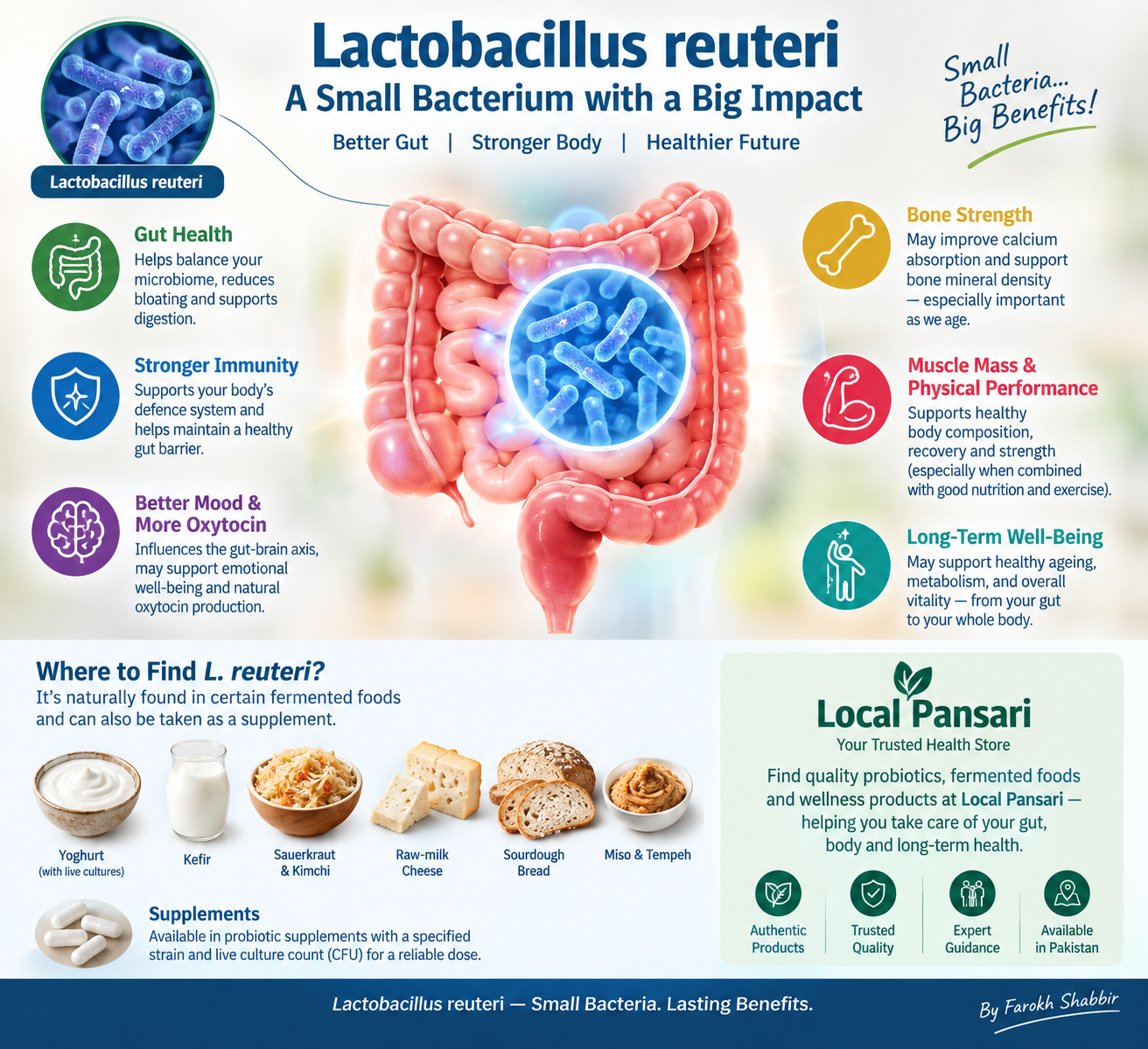
A. Digestive health and intestinal balance
One of the most practical areas of research is digestive health.
The intestinal microbiome participates in the breakdown of food components, interaction with the intestinal barrier and communication with immune cells. Certain probiotics may influence these processes.
Potential benefits being investigated include:
- Improvements in selected digestive symptoms.
- Changes in stool consistency and bowel habits.
- Support for a balanced intestinal microbial environment.
- Effects on intestinal inflammatory markers in particular clinical settings.
A randomized, placebo-controlled trial published in 2024 investigated a combination of DSM 17938 and ATCC PTA 6475 in 140 adults with irritable bowel syndrome (IBS). The researchers reported improvements in IBS-associated symptoms beginning around the sixth week of treatment, alongside changes in some measured outcomes. The results are promising, but they do not establish that every L. reuteri product will work for every person with IBS.[1]
It is also important to distinguish a probiotic’s possible effects on IBS from the treatment of inflammatory bowel diseases or other diagnosed gastrointestinal conditions. These are different clinical problems.
B. The gut–brain connection
The gut and brain communicate through several interconnected systems, including the nervous system, immune signaling and hormones.
This communication is often described as the gut–brain axis.
Researchers are investigating whether selected microorganisms can influence this system through their metabolites and interactions with intestinal cells. L. reuteri is of particular interest because some experimental findings suggest that it can affect biological pathways associated with oxytocin.
However, this does not mean that taking a probiotic will necessarily improve mood, reduce anxiety or change social behavior. These outcomes require appropriately designed human clinical trials.
C. Oxytocin: The hormone that makes L. reuteri especially interesting
Oxytocin is a hormone and neuropeptide associated with childbirth, breastfeeding, social bonding and other physiological functions. Its effects are complex, and it should not simply be described as a happiness or love hormone.
A 2016 study, Microbial lysate upregulates host oxytocin, reported that L. reuteri-related interventions affected oxytocin-associated pathways and wound healing in experimental models. The researchers also reported findings relevant to wound repair in human health.[2]
In a subsequent study, published in 2023, researchers investigated how L. reuteri interacts with intestinal tissue. They found that bacterial products could stimulate oxytocin secretion in human intestinal tissue and laboratory-grown intestinal organoids through a pathway involving the gut hormone secretin.[3]
These findings provide a possible biological explanation for how a microorganism might communicate with hormone-producing cells.
Nevertheless, three distinctions are essential:
- Demonstrating oxytocin secretion in isolated human tissue is not the same as demonstrating a sustained increase in circulating oxytocin after taking an oral supplement.
- Changes in oxytocin signaling do not automatically establish improvements in intimacy, emotional attachment, sexual function or psychological well-being.
- The effects may depend on the bacterial strain, the preparation used and the individual.
What can we conclude? L. reuteri–oxytocin research is scientifically interesting, but it is too early to recommend L. reuteri as a proven way to raise oxytocin or improve relationships.
D. Bone health and long-term skeletal maintenance
Bone health is another area in which L. reuteri has been investigated.
In a randomized, double-blind, placebo-controlled study published in 2018, researchers examined ATCC PTA 6475 in older women aged 75–80 with low bone mineral density. The trial included 90 participants, of whom 70 completed the study.
After 12 months, the researchers reported less loss of tibial volumetric bone mineral density in the probiotic group than in the placebo group.[4]
This finding is important because bone maintenance becomes increasingly relevant with ageing.
However, the study was relatively small and involved a specific population. It does not prove that L. reuteri increases bone density in all adults, builds stronger bones during adolescence, or prevents osteoporosis when used without other appropriate measures.
Adequate calcium, vitamin D, dietary protein, resistance exercise and appropriate medical assessment remain important components of bone health.
E. Immunity and inflammatory signaling
The intestinal lining is an important interface between the body and its external environment. The gut microbiome can interact with immune cells and influence local immune signaling.
Laboratory research suggests that certain L. reuteri strains may influence inflammatory pathways and produce substances that inhibit selected microorganisms.
These findings help explain why researchers are studying the bacterium in relation to immune function.
However, a laboratory observation is not proof that a supplement prevents infections, treats chronic inflammation or strengthens immunity in every healthy person. Such claims require evidence from human clinical studies that measure relevant outcomes.
F. Skin and wound healing
The 2016 study mentioned earlier also investigated wound healing in experimental models and reported human findings relevant to wound repair.[2]
This research raises the possibility that microbial products may influence tissue repair through pathways involving oxytocin and immune signaling.
It should not be interpreted as evidence that L. reuteri supplements treat acne, reverse ageing, heal chronic wounds or replace established wound care. Those are separate claims requiring specific clinical evidence.
Does L. reuteri Increase Growth, Height or Lean Body Mass?
This is an important question because some online discussions suggest that L. reuteri may influence growth, muscle development and body composition.
It is necessary to distinguish three separate outcomes.
A. Physical growth and height
During childhood and adolescence, height growth depends on genetics, nutrition, hormones, health and the condition of the growth plates.
Research into the gut microbiome and bone metabolism raises interesting questions about how microorganisms may interact with skeletal development.
However, there is currently insufficient human clinical evidence to conclude that taking L. reuteri increases height or accelerates normal physical growth.
In adults whose growth plates have closed, a probiotic cannot be expected to increase skeletal height.
B. Lean body mass (LBM) and muscle development
Lean body mass includes muscle, organs, body water, connective tissue and other non-fat components. It is not the same as skeletal muscle mass.
A systematic review and meta-analysis published in 2023 examined probiotic supplementation and body composition in adults. It found a possible improvement in measured muscle mass and global muscle strength across the included studies, but it did not find a significant improvement in total lean body mass.[5]
These results concerned multiple probiotic interventions, not L. reuteri alone. They therefore cannot establish that this particular bacterium increases LBM.
For someone trying to build muscle, the better-established priorities remain progressive resistance training, sufficient dietary protein, adequate energy intake, sleep and consistency.
C. Bone density versus muscle growth
Bone density, height and muscle mass are different outcomes.
A finding that ATCC PTA 6475 may help reduce bone loss in a specific group of older women does not establish that it increases muscle mass or height in younger adults.
Likewise, research showing changes in muscle outcomes with certain probiotics cannot automatically be applied to L. reuteri.
The current conclusion: L. reuteri may influence biological pathways relevant to skeletal health, but its ability to increase height, accelerate growth or produce meaningful gains in LBM remains unproven.
4. Can L. reuteri Improve Testosterone, Libido or Sexual Health?
Oxytocin and other hormonal pathways have led to considerable speculation about the effects of L. reuteri on sexual health.
Lactobacillus reuteri and Oxytocin: The Gut Bacterium Linked to the “Love Hormone”
One of the most fascinating ideas discussed by cardiologist Dr. William Davis in his book Super Gut is the potential relationship between Lactobacillus reuteri and oxytocin, a hormone commonly associated with love, trust, affection, social bonding, and emotional connection. Oxytocin also plays roles in childbirth, breastfeeding, and aspects of stress regulation. Dr. Davis proposes that restoring certain strains of L. reuteri in the gut may influence oxytocin signaling and potentially support emotional well-being, skin health, muscle maintenance, and aspects of healthy ageing. This theory has attracted considerable interest because it highlights the possible connection between the gut microbiome and the brain, often discussed under the term gut–brain axis.
Research in animals has provided promising clues: certain strains of L. reuteri, particularly ATCC PTA 6475, have been associated with changes in oxytocin-related pathways and improvements in some measures of social behaviour and tissue repair. However, it is important to distinguish these findings from established human evidence. Although oxytocin is a real and important hormone, it has not yet been conclusively demonstrated that consuming L. reuteri yogurt reliably increases oxytocin levels or produces all the benefits described in popular discussions of the “love hormone.” The effects may depend on the bacterial strain, the individual’s existing microbiome, and other biological factors.
At present, there is insufficient reliable human evidence to recommend L. reuteri as a treatment for:
- Low testosterone.
- Erectile dysfunction.
- Reduced libido.
- Infertility.
- Sexual performance.
- Hormonal deficiencies.
A probiotic may be investigated for indirect effects on general health, but it should not be considered a replacement for evaluating and treating an underlying hormonal or sexual-health problem.
Can You Get L. reuteri Naturally Through Food?
The original Wellgard article, What Foods Contain Lactobacillus reuteri?, discusses yoghurt, kefir, sourdough, fermented vegetables, cheese, miso and tempeh as possible sources or foods associated with fermentation.
These foods can contribute to a varied diet, but there is a major limitation: most do not provide a reliable, verified dose of a specific L. reuteri strain.
Regular yoghurt
Ordinary yoghurt generally contains starter cultures such as Streptococcus thermophilus and Lactobacillus delbrueckii subsp. bulgaricus. It does not necessarily contain L. reuteri.
Greek yoghurt is not inherently richer in L. reuteri; the name mainly refers to its thicker, strained consistency.
Kefir
Kefir contains a diverse community of bacteria and yeasts. Its exact composition depends on the starter culture and manufacturing process.
It may be a useful fermented food, but it should not be assumed to contain a particular L. reuteri strain.
Kimchi, sauerkraut and fermented cucumbers
Traditionally fermented vegetables can provide live microorganisms when they have not been pasteurized. However, the microbial composition varies, and L. reuteri is not guaranteed to be present.
Sourdough, cheese, miso and tempeh
These foods are produced through different fermentation processes. The presence of lactic acid bacteria does not establish the presence of L. reuteri in a meaningful quantity.
What about homemade L. reuteri yoghurt?
Some people prepare homemade yoghurt using specific L. reuteri capsules as a starter culture, milk and sometimes a prebiotic ingredient such as inulin.
The aim is to encourage bacterial growth during fermentation. However, the final bacterial count, strain composition and food safety cannot be assumed without appropriate testing and controls.
Long fermentation does not automatically mean a greater number of viable L. reuteri cells, and a homemade product cannot be assigned a reliable CFU count simply by following a recipe.
People who are immunocompromised, seriously ill or otherwise at increased risk from foodborne infection should seek medical advice before experimenting with homemade live-microbe preparations.
How Can You Obtain L. reuteri in Pakistan?
For someone in Pakistan, there are three practical routes to consider.
Look for a labelled probiotic supplement
One internationally recognized example is BioGaia Protectis, which contains the DSM 17938 strain. BioGaia Gastrus is another formulation that combines DSM 17938 and ATCC PTA 6475. Formulations and availability can vary by market.[6]
When comparing products, check:
- The exact strain name and reference code.
- The stated CFU count and whether it is guaranteed through expiry.
- Expiry date and storage requirements.
- Manufacturer and authorized distribution information.
- Whether the product contains additional ingredients that you need to consider.
A product labelled simply “probiotic” does not necessarily contain L. reuteri.
What Can You Buy From a Local Pansari?
Traditional pansari shops in Pakistan commonly sell herbs, seeds, spices and ingredients used in home remedies and traditional preparations.
However, a pansari shop is not a reliable source of a verified L. reuteri strain. The bacterium is a specific microorganism, not a traditional herb or powder that can be identified by appearance.
You can still use local shops to obtain complementary dietary ingredients.
Examples include:
- Flaxseeds (alsi): Provide fibre and alpha-linolenic acid, a plant-based omega-3 fatty acid.
- Chia seeds: Provide fibre and plant-based omega-3 fatty acids.
- Oats: Contain beta-glucan and other fibres.
- Garlic and onions: Contain fermentable carbohydrates that can be used by some gut microorganisms.
- Bananas: Provide fibre and, depending on ripeness, varying amounts of resistant starch.
- Isabgol (psyllium husk): A soluble fibre that can help support regular bowel movements when taken with adequate fluid.
These ingredients can complement a balanced diet, but none should be described as a dependable source of live L. reuteri.
How Long Does It Take to Notice Benefits?
There is no single timeline for L. reuteri because the outcome depends on the strain, dose, individual and reason for taking it.
A useful way to interpret the evidence is to separate observed study periods from expectations.
In the first few days: Some people notice changes in gas, bloating or bowel habits after starting a probiotic. Others notice nothing. These changes do not prove that the probiotic has colonized the gut or produced a long-term benefit.
Over several weeks: Some clinical outcomes may become measurable during this period. In the 2024 IBS trial discussed earlier, improvements in symptoms were reported from around week six.[1] This is a result from one study, not a universal timetable.
Over several months: Longer studies are needed to evaluate sustained changes in particular health outcomes. For example, the bone-health trial used a 12-month intervention.[4]
Over the longer term: There is insufficient evidence to predict that daily L. reuteri will produce progressively greater oxytocin levels, permanent colonization, increased height, increased LBM or a general improvement in longevity.
A longer duration of use does not necessarily mean a larger benefit.
Is Daily L. reuteri Safe?
Many commonly studied probiotic products are well tolerated by healthy people, although safety depends on the specific strain, product and individual.
Possible side effects include temporary bloating, gas or changes in bowel movements.
Before using a supplement, consider the following:
- Follow the product-specific instructions rather than copying a dose used in a different clinical study.
- Store it according to the label.
- Seek medical advice if you are immunocompromised, seriously ill or have a central venous catheter.
- Do not replace prescribed treatment for a digestive, hormonal or metabolic condition with a probiotic.
- Seek medical advice if symptoms persist or become severe.
If you are considering homemade fermented yoghurt, remember that contamination and uncertain bacterial counts are separate concerns from the safety of a commercially manufactured supplement.
A Practical Approach for Someone Interested in Overall Health
If the goal is to support digestion, general well-being, bone health and body composition, a sensible approach is to treat L. reuteri as one possible component of a broader health plan rather than a standalone solution.
A practical plan might include:
- Eat a varied diet containing vegetables, fruits, legumes, whole grains and suitable fermented foods.
- Obtain adequate protein and follow a progressive resistance-training programme if muscle development is a goal.
- Maintain sufficient calcium and vitamin D intake for skeletal health.
- Consider a probiotic only when its intended purpose, strain and product quality are clear.
- Track the particular symptom or outcome you hope to improve rather than relying on vague impressions of overall wellness.
- Discuss persistent digestive symptoms or suspected hormonal problems with a qualified healthcare professional.
A probiotic is most useful when there is a clear reason to take it and the expected benefit is supported by evidence relevant to the strain and health outcome.
Conclusion: Is L. reuteri Worth Exploring?
L. reuteri is an interesting microorganism because research extends beyond conventional digestive-health questions. Studies have investigated its interaction with intestinal cells, oxytocin signalling, immune pathways and bone metabolism.
The strongest conclusions are still specific rather than universal. Certain formulations have shown promising findings for selected digestive symptoms, and a particular strain has been investigated for bone health. Experimental research on oxytocin offers a possible biological mechanism, but it does not prove that supplementation will improve social bonding, libido, mood or overall hormonal health.
Likewise, there is not enough evidence to recommend L. reuteri as a way to increase height, accelerate physical growth or reliably increase lean body mass.
For people in Pakistan, the most practical starting point is to identify a properly labelled product containing the strain relevant to the intended use, verify its authenticity and consult a healthcare professional when appropriate. Local pansari shops can help supply fibre-rich foods and other dietary ingredients, but they cannot be assumed to provide a verified probiotic strain.
The most responsible way to approach L. reuteri is with curiosity, realistic expectations and an understanding of the difference between promising science and established clinical benefits.
by Farokh Shabbir
This article is for educational purposes only. It is not a diagnosis, a treatment recommendation or a substitute for professional medical advice.
References and further reading
[1] Cruchet S, et al. (2024). Limosilactobacillus reuteri DSM 17938 and ATCC PTA 6475 for the treatment of moderate to severe irritable bowel syndrome in adults: a randomized controlled trial. Frontiers in Gastroenterology.
https://doi.org/10.3389/fgstr.2023.1296048
[2] Poutahidis T, et al. (2017). Microbial lysate upregulates host oxytocin. Cell Host & Microbe.
https://pmc.ncbi.nlm.nih.gov/articles/PMC5431580/
[3] Microbial stimulation of oxytocin release from the intestinal epithelium via secretin signaling. Research published in 2023.
https://pmc.ncbi.nlm.nih.gov/articles/PMC10028957/
[4] Nilsson AG, et al. (2018). Lactobacillus reuteri reduces bone loss in older women with low bone mineral density: a randomized, placebo-controlled, double-blind, clinical trial. Journal of Internal Medicine, 284, 307–317.
https://doi.org/10.1111/joim.12805
[5] Impact of probiotics on muscle mass, muscle strength and lean mass: a systematic review and meta-analysis of randomized controlled trials. Journal of Cachexia, Sarcopenia and Muscle (2023).
https://pmc.ncbi.nlm.nih.gov/articles/PMC9891957/
[6] BioGaia. Official product information and purchasing information.
[7] Wellgard. What Foods Contain Lactobacillus reuteri? Updated July 2026.
https://wellgard.co.uk/blogs/health-insiders/what-foods-contain-lactobacillus-reuteri