







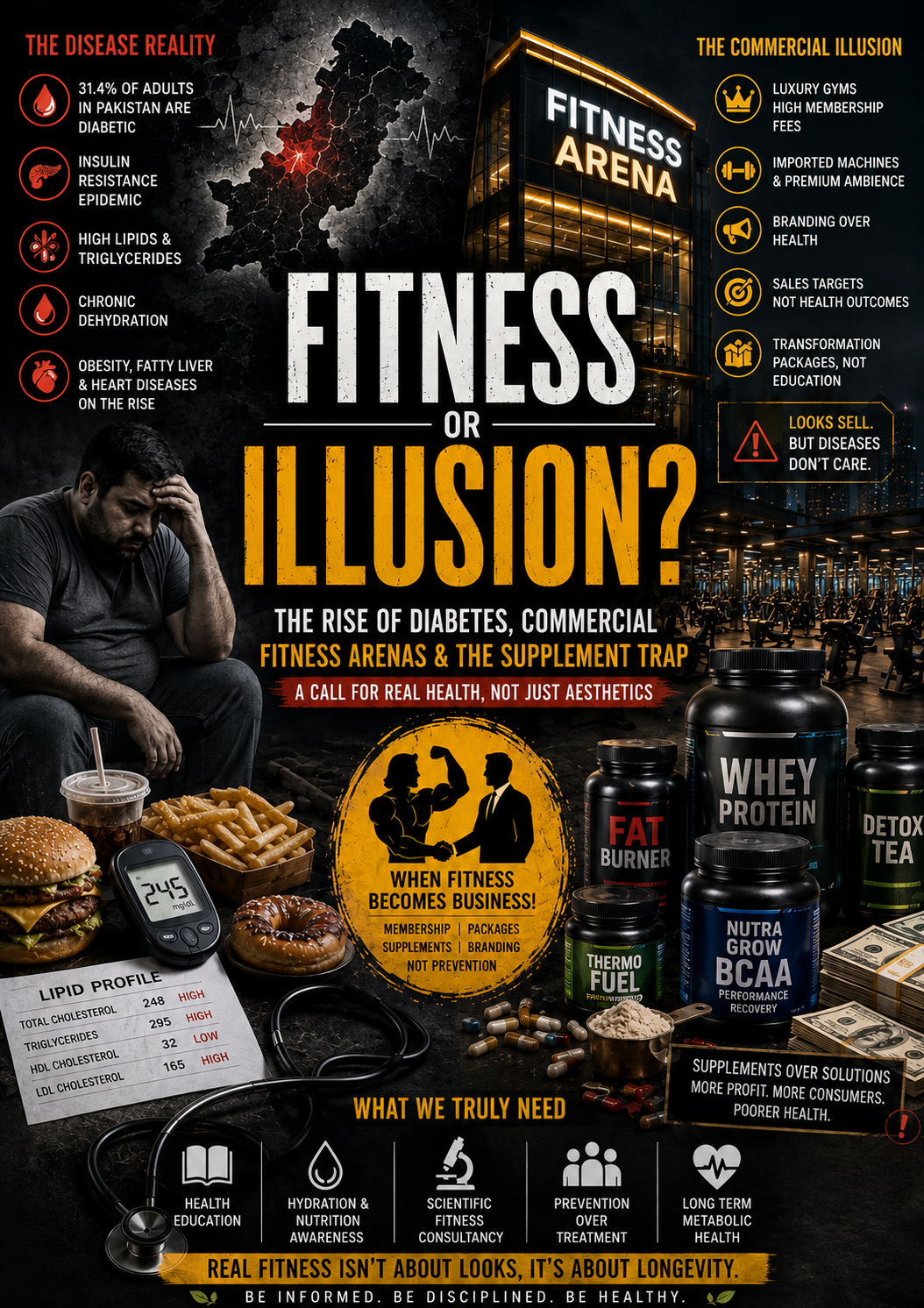
The Commercial Illusion of Fitness in a Diabetic Pakistan
Growing Metabolic Health Crisis
“The Commercial Fitness Industry Pakistan crisis reflects a dangerous shift where wellness is increasingly commercialized while metabolic diseases continue to rise.”
Pakistan is not merely facing a healthcare issue; it is confronting a full scale metabolic collapse. According to the International Diabetes Federation (IDF), nearly 31.4% of Pakistan’s adult population is living with diabetes, placing the country among the highest in the world for Type 2 diabetes prevalence (IDF, 2024). Yet behind this statistic lies a darker reality: millions more remain undiagnosed, silently progressing toward insulin resistance, obesity, cardiovascular disease, fatty liver , hypertension, chronic inflammation and premature mortality.
The modern Pakistani lifestyle has become a perfect breeding ground for metabolic destruction. Processed food consumption has increased, physical activity has declined, sleep cycles are severely disrupted, hydration levels are chronically poor, and stress has become normalized as part of urban survival. The average individual today survives on excessive carbohydrates, sugar loaded beverages, trans fats, low protein intake, and dangerously inadequate water consumption. As a result, insulin levels remain elevated for prolonged periods, forcing the body into continuous metabolic stress. High triglycerides, abnormal lipid profiles, visceral fat accumulation, and declining muscular health have now become common even among younger populations.
Yet ironically, while the nation sinks deeper into lifestyle disease, the fitness industry continues to market illusion instead of rehabilitation.
The Pakistan Diabetes and Commercial Fitness Industry Connection
Across Pakistan’s major cities, fitness arenas rise like corporate monuments, massive buildings decorated with imported equipment, neon lighting, marble interiors, luxury reception areas, and aggressive branding campaigns. Membership packages are sold as symbols of status and prestige. However, beneath the glamour lies a painful truth: many of these institutions contribute very little toward solving the country’s actual health crisis.
Turning fitness centers into high rise buildings does not heal insulin resistance.
Installing expensive treadmills does not reverse Type 2 diabetes.
Decorating gyms with luxury interiors does not improve public metabolic health.
The core problem remains untouched because the industry has prioritized commercialization over education.
Most fitness arenas function more like aesthetic clubs than scientific wellness institutions. Their business model revolves around appearance driven transformation rather than evidence based health restoration. Trainers are frequently taught to sell motivation, body image, and temporary fat loss programs while lacking even fundamental understanding of endocrinology, insulin regulation, lipid metabolism, hydration science, or diabetic physiology.
Pakistan Diabetes and Commercial Fitness Industry and the Supplement Economy
Many so called “consultants” prescribe generic meal plans copied from the internet, unrealistic starvation diets, excessive cardio routines, and supplement heavy regimens without considering hormonal balance, medical history, or long term sustainability. Some trainers can explain bicep curls in detail, yet cannot explain how chronic dehydration impacts blood viscosity, glucose regulation, and cardiovascular strain. Others promote “sweating out fat” while ignoring the biochemical damage caused by prolonged insulin spikes and inflammatory eating patterns.
At the same time, it is important to acknowledge that a small number of fitness consultants are genuinely attempting to contribute positively at an individual level. Some independent professionals invest time in educating clients about nutrition, hydration, mobility, insulin sensitivity, and sustainable health practices. They attempt to bridge the gap between medical awareness and practical lifestyle correction. However, their efforts are often overshadowed by the larger commercial ecosystem dominating the industry.
On the other hand, many individuals within the fitness market have transformed the health crisis itself into a business opportunity. Instead of solving public concerns, they capitalize on insecurities by aggressively promoting supplements, fat burners, artificial transformation packages, and branded nutrition products. In several cases, consultants gradually evolve into supplement sellers and manufacturers whose primary focus shifts from rehabilitation toward revenue generation. The industry then becomes less about restoring health and more about creating permanent consumers dependent upon powders, pills, and commercial products.
The Failure of Scientific and Preventive Fitness
The tragedy becomes even more alarming when diabetic or obese individuals enter these gyms seeking genuine recovery. Instead of receiving structured metabolic rehabilitation, they are often pushed toward rapid transformation challenges, social media aesthetics, or unrealistic body standards. The result is predictable: temporary motivation followed by burnout, injury, relapse, or worsening health conditions.
Pakistan’s fitness industry suffers from a dangerous shortage of professionally developed consultants who combine scientific literacy with practical health management. Real fitness consultancy requires deep understanding of nutrition science, insulin sensitivity, cardiovascular conditioning, hydration management, behavioral psychology, stress adaptation, sleep optimization, and chronic disease prevention. Unfortunately, such multidisciplinary expertise remains rare.
The public health crisis cannot be solved through mirrors, machinery, and membership cards alone.
A nation suffering from insulin resistance needs education.
A population battling obesity needs preventive systems.
People with high lipids and chronic fatigue need metabolic rehabilitation.
Communities struggling with dehydration, poor nutrition, and sedentary lifestyles need awareness campaigns, not merely luxury gym launches.
The Disconnect Between Healthcare and Fitness
Moreover, the healthcare and fitness sectors continue operating in isolation when they should function collaboratively. Doctors prescribe medication, gyms sell workouts, nutritionists work independently, and patients remain trapped in confusion. There is little integrated effort toward sustainable lifestyle correction. Consequently, many individuals become lifelong consumers of medication while the root causes of disease continue to intensify.
The obsession with appearance based fitness culture has also distorted society’s understanding of health itself. Visible muscles are celebrated while internal dysfunction remains ignored. A person may appear physically fit on social media while simultaneously suffering from elevated fasting insulin, poor hydration, chronic inflammation, liver stress, and deteriorating cardiovascular health. True wellness cannot be measured by lighting, angles, or physique alone.
Pakistan urgently requires a revolutionary shift in its fitness philosophy. Fitness arenas must evolve into genuine health education and rehabilitation centers rather than corporate showpieces. Trainers should be scientifically certified, metabolic assessments should become routine, hydration and nutrition education should be mandatory, and public awareness campaigns must address insulin resistance long before diabetes develops.
In conclusion, Pakistan’s diabetes epidemic reflects not only medical failure but also the commercialization of wellness itself. The nation does not need more glamorous fitness towers pretending to solve health problems through aesthetics and branding. It needs a system built upon science, education, prevention, and authentic human rehabilitation. Until fitness institutions begin addressing the real metabolic crisis involving insulin resistance, high lipid disorders, chronic dehydration, and lifestyle dysfunction, the country will continue producing unhealthy populations beneath the illusion of modern wellness.
References
- International Diabetes Federation (IDF). Diabetes in Pakistan (2024). IDF Diabetes Atlas. Available at: https://idf.org/our-network/regions-and-members/middle-east-and-north-africa/members/pakistan/
- Basit, A., et al. (2019). Diabetes Prevalence Survey of Pakistan (DPS PAK): prevalence of type 2 diabetes mellitus and prediabetes using HbA1c. BMJ Open, 9(2).